
Plotting Wall Street Bankers on the Saddam Hussein – Salem Witch Trials Continuum
Posted by Jeff Lipshaw
Imagine how difficult public debate in these partisan times can be for someone like me whose motto is “extremism in the pursuit of moderation is no vice.” I haven’t seen Inside Job, but I have read the reviews, good and bad, and I think I get the point. I confess to never having seen a Michael Moore “documentary,” A Civil Action, or Erin Brockovitch. But this is from a reviewer, Keith Uhlich in TimeOut New York, who liked it, and it doesn’t inspire me to fork over the twelve bucks: “Ferguson uses innumerable tricks of the slick-doc trade (pop-music montages; gotcha smash cuts; celebrity narration—in this case, Matt Damon). Even the title is a loaded, tragedy-invoking provocation.” Nor am I enticed by the appeal to post-partisanship in the pursuit of outrage, as Uhlich describes it: “Ferguson’s trying to move beyond the political dichotomies that divide us into bellowing factions and show how rampant greed screws us all.”
Since I’m about to fly off to Minneapolis to give a milk-toasty response (see above motto) to the question “Did Capitalism Fail?” (my answer: Capitalism Didn’t Fail, But the Metaphors Got a “C”), I decided I ought to think for a little bit this morning whether I was wrong, and director Ferguson was right. I thought that particularly because my friend Frank Pasquale at Concurring Opinions also liked the movie a lot, and that means I have to take it seriously, if for no other reason that Frank has taught me so much on other issues. As I expected, Frank gets past the slick doc stuff (I cringe at the idea of watching the 60 Minutes-style “did you stop beating your wife?” questions) and suggests there are four arguments being made: (1) Wall Street compensation is loopy; (2) the Obama administration hasn’t done anything to create reform, instead relying on the same bankers as the Bush administration; (3) the Obama administration is as taken with the revolving door cabal of “Goldman Sach alums and fail-upward regulators” in which it is no longer possible to determine who captured whom; and (4) the U.S. has turned into a financial (rather than mechanical, civil, bio, or electrical) engineering power bound to lose out to China and others in the long run. I also think Frank’s review is honest in describing its own position (see contra my motto above): “I’ll be looking beyond the core of the economics profession for a compelling account of a fair and just society. When it comes to finance, progressives should also realize they have few friends in the current administration.”
I realize, however, that my milk-toasty approach hasn’t quite failed me (I can’t speak for others). My essay is about the relationship between causation, as scientists would explore it, and meaning, as the rest of us would derive it. The approach of Inside Job is less an explanation of what happened than a narrative of its meaning. I’m still agnostic on the question whether “rampant greed screws us all” mainly because I like my MacBook and my iPhone, and I think they are the products of rampant greed. On the other hand, I recently turned down the opportunity to invest in a derivative akin to a synthetic CDO in part because the idea of it bugged me, even though I had no good response to my broker why it was any worse than investing in the underlying market.* As I note in the essay, one way to interpret events for their meaning is to decide whether misfortune is the result of gods or demons, and sometimes it is. Sometimes, however, it is “stuff happens.” (I decided I wanted this post printable someday in a family newspaper.) We are, however, imbued with a tendency to teleology, that is, the seeing of purpose (even if purpose is no more than “function”) when things like solar systems, automobiles, and macro-economies seem to work with a predictability regularity. I like graphs, however, and I came up with this one as I was walking to the T this morning:
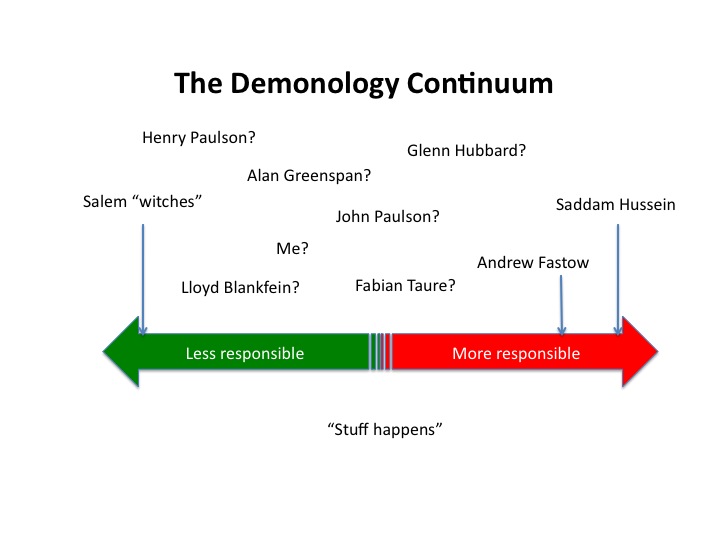
My point is not that there are never culpable demons, but that sometimes those who we think are culpable demons are not. I have not yet been persuaded by the level of public discourse (Ann Coulter? Sarah Palin? Michael Moore? Glenn Beck? Jon Stewart? Stephen Colbert?) that we can say we’ve reached a level of rationality such that witch trials were then, and now is now. What is comforting is that at least I can have a reasoned and civil discussion with Frank, without the sound bites, even if we don’t agree!
*UPDATE: Actually, I did come up with a reason or rationalization but it’s almost as complicated as the investment vehicle, so I won’t bother explaining it.