
Samuel Warren and Louis Brandeis, “The Right to Privacy,” goes digital, with my Foreword
Posted by Alan Childress
Admittedly 120 years too late, and not exactly on-topic to the blog, but Warren and Brandeis have now 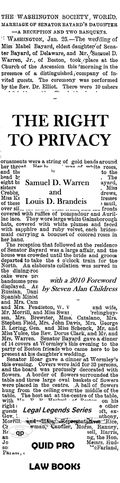
I wanted to post a link to the Amazon DTP version of The Right to Privacy and my Foreword and other materials in the compilation (including active TOC, linked notes, and period photos and press clips provided to me, graciously,
by Amy Gajda, who did extensive research up on SSRN on the infamous backstory). Sorry to charge for the ebook, but that is Amazon rules for non-bigtime-publishers (and I must make it a buck more on July 1). You can get my own contribution part of it free anyway, below.

Any free Amazon app for those devices, even just on the PC or a laptop, will work great to read this and their ebooks (which do include 20,000 free classics), or on Kindle. I will try to post some more old pics later this week…
From the blurb:
Themost influential piece of legal scholarship in history, many scholars say, isthis 1890 Harvard Law Review articleby two Boston lawyers (one of whom later became a legendary Supreme CourtJustice). Warren and Brandeis created –by cleverly weaving strands of precedent, policy, and logic — the legal concept of privacy, and the power oflegal protection for that right. Theirclear and effective prose stands the test of time, and influenced such modernnotions as “inviolate personality,” the law’s “elasticity,”and the problems of “piracy.” Theyresisted the label of “judicial legislation” for theirproposals. And they foresaw the threatof new technology.
Most ofall, they asserted the fundamental “right to be let alone,” and itsimplications to modern law are profound. Their privacy concept has grown into a constitutional law norm raisingissues about abortion, drug testing, surveillance, sexual orientation, freespeech, the “right to die,” and medical confidentiality. All these spinoffs trace their origins tothis master work. It is simply one ofthe most significant parts of the modern canon of law, politics, and sociology.
The Foreword shares not only this import and effect, butalso the fascinating backstory behind the article. Its origins are found in Warren’s own pricklyexperiences with the press, famously after its reports on his familyweddings. One myth was recently debunked by Gajda: it could not have been his daughter’s weddingthat upset him. The newer legend isexplained, including the role of TheWashington Post and the emerging paparazzi. This was no mere academic exercise to Warrenand Brandeis, it turns out. The Forewordadds a biographical summary of each author, noting some less-known questions aboutBrandeis’s own judicial ethics later in life (debunking another myth), as wellas noting the possible tension between the privacy right and the FirstAmendment that Brandeis championed.
If readers here want to do a similar compilation, formatting, and Foreword to classic legal scholarship in pre-1923 U.S. books, for digital readers, ask quidprolaw@gmail.com . You must be willing to write original work or annotations, and work from source materials not just scanned crap. The goal is high quality ebooks, not the formatting nightmares that are out there now (even the online versions of The Right to Privacy are all full of substantive errors, including one on a Harvard site!)
[You can also, without needing an app, Download Foreword TRTP2]