
How the “Cravath System” Created the Bi-Modal Distribution
[posted by Bill Henderson, crossposted to ELS Blog]
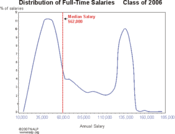 The bi-modal distribution (graphic to the right, originally posted at ELS) continues to generate interest in the blogosphere. See, e.g., Greg Mankiw, Right Coast, Broken Symmetry. The chart summarizes the starting salaries for lawyers who graduatedfrom law school in 2006. One reason the bi-modal structure is sojarring is that it demonstrates that measures of central tendency, suchas average or median, are not necessarily reliable guides for lawstudents’ future earning power. In conventional labor markets, thatdisconnect is rare.
NALP recently dug into its archives to determine whether thisstratification is a persistent feature of the entry level law market. See NALP Bulletin (Jan. 2008). It turns out that 15 years ago, the market followed a much moretraditional distribution. The chart below summarizes the salaries forthe class of 1991.

The 1991 graph is right skewed but bears some resemblance to a normal curve. Below is the graph for 1996:

The rightward skew is a bit more pronounced and the area under the$75K to $85K range is becoming more substantial. A more seismic shiftis seen in 2000 (below) with the emergence of a second mode at the$125K price point.

At the height of the Internet boom, a remarkable 14% of all entrylevel lawyers took jobs at the $125K level. According to NALP, “neverbefore had a single salary so dominated the landscape.” Under the 2006bimodal distribution (see chart above),44% of graduates received entry-level salaries in the $40K to $60Krange; yet, the second mode moved further to the right ($135K to $145K) andgrew to 17% of all graduates.

What are the market forces that have created this peculiar salary structure? In my working paper, “Are We Selling Results or Résumés?: The Underexplored Linkage Between Human Resource Systems and Firm-Specific Capital,”I posit that the runaway $160K mode is a confluence of two factors: (1) the continued growth in the corporate legal services market,primarily due to the growing scale and scope of transnational corporateactivity; and (2) law firms’ nearly universal adherence to the “Cravath system,”which purports to hire the best graduates from the best law schools andprovide them with the best training. More after the jump. …
The New York firm ofCravath Swaine & Moore created and refined this system during theearly 20th century. The emphasis on educational credentials wasinitially an attempt to establish a distinctive brand of legal servicesthat could differentiate the firm from other Wall Street competitors.Now, ironically, it has become a uniform industry practice utilized byevery large law firm that claims to provide first-rate services. [Virtually all firms mimic the Cravath system without understandingits logic. Inthe paper, I draw upon a unique study of engineers at the renown BellLabs to suggest that Cravath’s superior client service has less to dowith credentials than an organizational structure and ethos that alignsthe interests of associates, partners, and clients. Paul Cravath’stheory is laid out in Robert Swaine’s history of the firm. I will discuss his profound disconnect in a subsequent post.]
On one level, law firms’ reluctance to tinker with the Cravathsystem makes perfect sense–it has produced large incomes and hugeprofits margins for decades. Further, 30 or 40 years ago, the vastmajority of firms that would eventually become the Am Law 200 were, infact, “white shoe” firms within an overwhelmingly regional corporatelegal market. In particular, places like Cleveland, Detroit,Pittsburghand St. Louis garnered their share of elite law school graduates. Inthe early 1960s, sociologist Jack Ladinsky found that 73%of Detroit lawyers working in law firms (i.e., not in solo practice)went to one of five national schools: Harvard, Yale, Columbia,Chicago,or University of Michigan. See Ladinsky, Careers of Lawyers, Law Practice, and Legal Institutions, 28 Am. Sociology Rev. 47, 49 (1963). You can bet this pattern is radically different today.
As these regional law firms morphed into the Am Law 200,their partners remained psychologically wedded to their own perceptionsof eliteness. In the ensuing salary wars, these firms slavishly paidthe prevailing rate rather than signaling to the market that the firmhad become “second rate” (a term used by a Proskauer Rose partner in rationalizing the higher pay). In turn, the laws of supply and demand produced the bi-modaldistribution.
The Results or Résuméspaper draws upon two pieces of market data to demonstrate that a largeproportion of large corporate law firms have to re-evaluate theirbusiness models: (1) stunning uniformity of associate entry levelsalaries amidst large, growing disparities in profits per partner; and(2) evidence that firms are becoming stratified by premium versusnon-premium practiceareas.
Regarding the disconnect between associate and partner pay, thebar chart below compares associate starting salaries with profits perequity partner at the 25th, 50th, 75th, and 95th percentile breakpoints inthe Am Law 200.
As the paper documents,over the last several years, profits are going up at all levels of theAm Law 200; they are just going up much faster for high PPP firms. Obviously, when firms at the top of the heap (95th percentile) payhigher salaries and bonuses, it is quite a stretch for firms at the25th percentile to match. The money has to come from somewhere. If itcomes out of the draw of a rainmaking partner, he or she has a strongincentive to seek greener pastures. That is risky; but to the majorityof the partnership, departing from the Cravath model seems equally perilous. Over the last decade, virtually all large firms have adapted byincreasing leverage (i.e., the ratio of total lawyers to equitypartners). But higher leverage can also undercut associate morale andloyalty. So for firms at the bottom of the PPP distribution, thesalary wars are one hell of a vise, particularly as the economy heads south and they are stuck with a $160,000+ cost structure.
Yet, for many firms, there is second trend that is much moretroubling. Based on adataset of lateral partner mobility within the Am Law 2000, it ispossible to tease out a relative hierarchy of practice areas. Thetable below, which covers the 2000 to 2005 time period, orders legalspecialty by differential profits per equity partner (PPP) between thefirma partner left and the firm he or she joined.
The trends are straightforward. Partners in marquee practices likewhite collar crime, securities enforcement, M&A, private equity,emerging markets, and intellectual property litigation aredisproportionately moving upstream to more profitable firms. Partners specializing in regulatory compliance, realestate, public finance, project finance, and trust & estates aredisproportionately moving downstream. A similar analysis usingmultivariate regression, which controlled for year and city, found thatlabor & employment was also associated with downward (i.e., lower PPP) movement. (See regression table.)
In the long-run, firms without a optimal mix of premium practiceareas will have a hard time sticking with the Cravathsystem. Increasingly, corporate clients are refusing to have theircases staffed by expensive first- or second-year associates who don’tknow very much and tend to leave. Hence, the training the clients areallegedly paying for has little or no future payoff.
In other words, for many large law firms, the wheels of theirhallowed business model are falling off. During this period of denial,every firm’s short term strategy is to work harder, promote fewerlawyers to equity partner, and de-equitize as needed. Marc Galanterand I chronicle the unremitting nature of modern large firm practice inour forthcoming Elastic Tournament article. If you have any doubt about the inevitability ofchange, read this seminal speech by Cisco GC Mark Chandler.
Fortunately, the Results or Résuméspaper lays out a solution for any law firm willing to try somethingnew. The psychological barriers, however, are much larger than thelogistical or financial. I will blog on this topic in a subsequentpost.