
Evolutionary Theory on Belief
Posted by Jeff Lipshaw
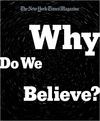 I swear I read The New York Times Sunday Magazine for the articles (and the crossword), not the pictures. Which is why I skipped yesterday’s “Soft Core on Campus” in favor of “Why Do We Believe? How Evolutionary Science Explains Faith in God” by Robin Marantz Henig.
This is another in the recent round of articles, inspired by the “unholy trinity of neo-atheists,” Richard Dawkins (The God Delusion), Sam Harris (The End of Faith), and Daniel Dennett (Breaking the Spell), that explores the boundaries between science and faith. Recently, Time hosted a dialogue between Dawkins and Francis Collins, the director of the Human Genome Project, who is a believing Christian, and wrote The Language of God.
It is an interesting article, with evolutionary accounts for three phenomena: agency detection (those who presume an animus in a rustling sound – i.e., that it is a sabertooth tiger and not a rush of wind – are more likely to survive and propagate), causal reasoning, and theory of mind (i.e., understanding that others have an internal point of view like your own). The problem, of course, with this framing of the debate, while suitable enough for the pretentious folks who read the NYT Sunday Magazine, is that it still pits extreme versus extreme – the atheist who says belief is delusion against the fundamentalist to whom God is as real as my office mates. All of which is not particularly helpful to those (like me) I like to think of as transcendental agnostics. We TAs generally take the accommodationist (or Kantian) route of distinguishing between what can be known empirically as truth, and that which, even if we believe it to be universal and is often expressed as a “truth,” can never really be known to be true.
Here’s an additional take from a great thinker, Christine Korsgaard (Harvard – Philosophy, right), on this issue. Suppose, she tells us, that there is science that gives morality a genetic basis. Assume further it has been proved empirically that “right actions” are those which promote the preservation of the species, and “wrong actions” do the opposite. Accordingly, we have evolved into beings with a strong sense of “right” and “wrong.” But, she asks, even if you believe the theory as a matter of explanation, would it “be adequate from your own point of view” in making moral decisions?
While it is true that a theory which cannot justify moral conduct normally also cannot explain why anyone who believes that theory acts morally, the basic philosophical problem here is not one of explanation. The case of the evolutionary theory shows that a theory could be adequate for the purposes of explanation and still not answer the normative question. And there is an important reason for this. The question how we explain moral behaviour is a third-person, theoretical question, a question about why a certain species of intelligent animals behaves in a certain way. The normative question is a first-person question that arises for the moral agent who must actually do what morality says. (Christine M. Korsgaard, The Sources of Normativity (Cambridge, Cambridge University Press, 1996), 14-16.)
Why does this have any bearing on, or place in, a blog about the legal profession? Because Korsgaard’s “bugbear,” the “Scientific World View,” which holds normativity at arms’-length in favor of explanation, may well be at work in a discipline like law, in which we are far more comfortable giving third party scientific explanations (Langdellian or Posnerian, no matter) than addressing the first-party moral issue. Or as Brian Tamanaha has suggested, viewing what lawyers do as amoral instrumentality.